Notes: Code Smell

My notes about life, work and other fascinating things around me.

Shown: 0 · Page

Wrong Freeway Entrance
14 November 2023 ·

Have you ever taken the wrong freeway entrance? You need to drive to the next exit to turn around, but you hate every inch of travel because you're going away from your goal.

― Andy Weir, "The Martian"

Programmers have exactly the same emotions when they spend a long time working on something. They suddenly realize that part of it should be designed differently. Moreover, this is exactly what you have to do since it solves several problems at once. This is where technical debt is born.

However, right now you don’t change anything but continue to work with the part of the code that already exists. After all, you are professional, and you have a release date! You have to make it on time and then pay the debt, but you hate every inch of code you write because you're going away from your goal.
In a Pedantic Way
21 Marth 2023 ·

The daily award for the most philosophical code goes to the author of this elegant way to check that two boolean variables are not equal to each other:

If DataStructure.Property("AmountVATIn")
    And ((DataStructure.AmountVATIn And NOT SearchPriceIncludesVAT)
    OR (NOT DataStructure.AmountVATIn And SearchPriceIncludesVAT)) Then    
    Price = RecalculateAmountOnVATFlagsChange(Price, DataStructure.AmountVATIn, TabSectionLine.VATRate);
EndIf;

I'm thinking of adding something like “And Not (DataStructure.AmountVATIn = SearchPriceIncludesVAT)” here to spice it up with a subtle note of insanity.

Do Not Confuse
16 Marth 2022 ·

Code

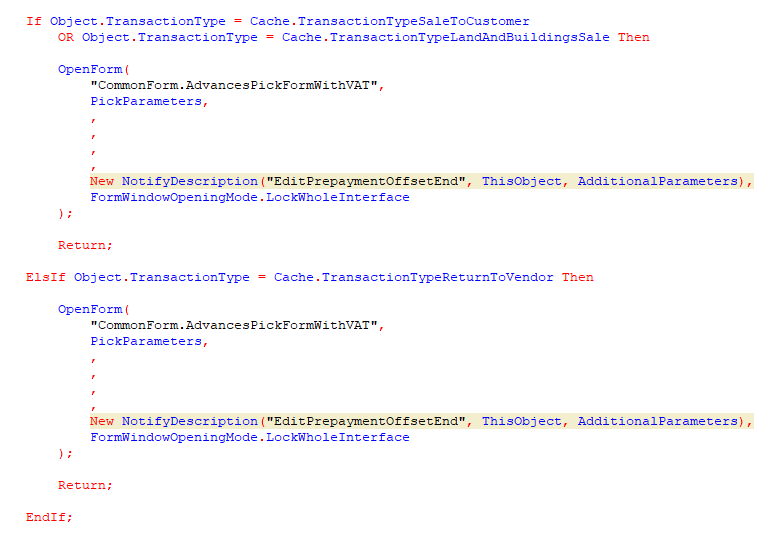
If the type of operation is the sale of goods or real estate, then open the common form AdvancesPickFormWithVAT with the parameters defined in the PickParameters structure. The callback is EditPrepaymentOffsetEnd method, defined in the same module; pass it the AdditionalParameters structure. The form needs to be opened so that it locks the whole interface.

However, if the type of operation is a return to the supplier, then open the general form AdvancesPickFormWithVAT with the parameters defined in the PickParameters structure. The callback is the EditPrepaymentOffsetEnd method, defined in the same module; pass it the AdditionalParameters structure. The form needs to be opened so that it locks the whole interface.

I hope you won't confuse.

Hammer & Nails
15 September 2021 ·

I was developing payment documents in our configuration last week and came across an incredibly redundant solution to a primitive problem. Sorry, I can't keep to myself.

Just imagine: you have a document, which contains several tabular sections. Each of them has a comment field. You make a print form for this document; if at least one row of any TS contains a comment — you need to use one template 1, if there are no comments — template 2.

The task is pretty primitive, isn't it? All of us have done something like this a million times. Just read the selection, use IsBlankString() on the comment field and load the appropriate template. Coffee time!

However, instead of a short cycle, I saw this:

There is a chain of queries, in the lowest of which we scan all the TS (which, I remind you, we just raked out for printing). We are looking for comments in them, then we group the result several times and return it to the script.

Well, I'm not even talking about the load on the DBMS (I would venture to guess that this trick doesn't give a noticeable effect — after all, the selection is going to be small). It's just… Well… Checking a selection of rows is, like, five lines of code. Clear, simple, short, Sonar has no room to swear. How could you give birth to this? Because of great love for queries?

You know what? I bet that it's the correct answer. I can almost see this programmer, who has just mastered the query language more or less tolerably. He is in the absolute delight of new opportunities, so… If all you have is a hammer, everything around looks like nails.

No Comment
8 September 2021 ·

I did not notice when I gave up the habit of pedantically commenting on every method with which I have to work. This practice has some clever name for sure, but I don't care, to be honest. I mean the style when a description is added to every meaningful block of code, like this:

The meaning here is simple: when you dig in some dense legacy and run back and forth between chaotically scattered, big procedures — it is rather difficult to keep the logic of each of them in your head. The next cup of coffee will wash everything away. Therefore, such notes greatly speed up orientation on the ground, and the more time passes between approaches to the code, the more noticeable the effect.

However, at some point it became clear that this know-how is just a crutch supporting the frankly crappy code design. If you have a long procedure or function - take a breath, sit down and cut the fatty one into smaller methods. You will save both time and nerves, and you will figure out the code faster, and you will delight SonarCube.