Notes: 1С

My notes about life, work and other fascinating things around me.

Shown: 0 · Page

Pause()
30 April 2023 ·

An important detail: the CallPause method is not available in a client-server call; when a client calls a server method in which CallPause is called, the exception "Cannot call the CallPause method in a client-server call" will be thrown.

CallPause Method (RU)

What a strange restriction, to be frank. On the one hand, an experienced developer will not make an intentional pause in a client-server call anyway; on the other hand, whoever wants to make it makes it anyway (by checking time in a cycle, for example). Does security by obscurity worth the efforts?

At best, some junior will catch this exception, think “welp, it looks like I'm doing something wrong” and move in the right direction. However, putting the restriction on the platform for the sake of this case is like firing a cannon at sparrows. You know what? Let's implement a number limit as well — like, no more than 1000 pauses per session, otherwise users will suddenly think that the program is too slow :-)

In a Pedantic Way
21 Marth 2023 ·

The daily award for the most philosophical code goes to the author of this elegant way to check that two boolean variables are not equal to each other:

If DataStructure.Property("AmountVATIn")
    And ((DataStructure.AmountVATIn And NOT SearchPriceIncludesVAT)
    OR (NOT DataStructure.AmountVATIn And SearchPriceIncludesVAT)) Then    
    Price = RecalculateAmountOnVATFlagsChange(Price, DataStructure.AmountVATIn, TabSectionLine.VATRate);
EndIf;

I'm thinking of adding something like “And Not (DataStructure.AmountVATIn = SearchPriceIncludesVAT)” here to spice it up with a subtle note of insanity.

Slow down, I'm recording
5 Marth 2023 ·

Usually the idea of developing is simple: the faster it works, the better. For example, the more requests an application manages to execute per unit of time, the faster the task for which these requests are needed will be solved.

However, it also happens the other way around: you need to reduce the number of operations that a program is able to perform. Let's imagine we exchange data with an external service and it bans if we hit it with requests too often. For example: the cloud version of Bitrix24 requires sending requests to it no more than two per second.

Here is an implementation of such a slowdown, which I wrote last week. There is no queue support; the main solved problem is to execute as many requests as possible without going beyond the limit (taking into account the fact that requests can be made from different sessions).

The problem is solved through a constant that stores the date for the current second and the number of requests that have already been sent. Clients who run into a limitation are waiting. This approach is not suitable for high-loaded systems, but otherwise it can come in handy.

REST service for Service Manager
25 February 2023 ·

This week, I developed a REST service to set up our service manager (this is a configuration for managing a 1cFresh instance). Deploying the development environment is a regular task for us, and every time the manager's database had to be tuned by hand: tweaking the storefront, changing application addresses, overwriting scheduled tasks, and so on.

The implementation was simple. Come up with a JSON structure, write a parser, find a code in the configuration, make it work by external call, and make sure you don't break anything. Routine work, in general, but I love to do such things from time to time: I mean, to look around and try to figure out which of the daily tasks is annoying enough.

This one is a good example. To be frank, setting up the Service Manager wasn't a problem (launching the app and fiddling with the settings), but it was a thing to pay attention & spend time to. What do we have now:

  1. There is a JSON file with all the settings;
  2. There is a REST service for its processing;
  3. There is a script that will put the first into the second;
  4. There is a pipeline that will do it all by itself.

In short, a boot was rubbing a leg, and now it isn't. Yahoo!

Haul Trucks
20 February 2023 ·

Cars

The colleague grumbled that if you think like that, then the configurator will be Zhiguli, and the EDT will be Kama1 (this is an electric car that has been developed somewhere in the depths of KAMAZ for many years and still can’t gather strength and, finally, show the wonder to the world).

Well, I try to look at things with optimism. I think the platform and its IDE are such haul trucks. No one in their right mind rides them on household chores, but these beasts are irreplaceable on a cut!

Shaken, Not Stirred
7 August 2022 ·

Let's speak a bit about organization of the code. If you need to describe a set of objects with common properties, think about whether this description should be divided into separate methods, each of which intended to describe one specific object?

Let's look at this example — a method that describes tabular parts of documents suitable for some task:

SupportedTypes["Document.SupplierPricesEntering"]   = "Prices";
SupportedTypes["Document.OpeningBalancesEntering"]  = "CustomerAccounts,VendorAccounts";
SupportedTypes["Document.Requisition"]              = "InventoryAndServices";

Everything seems fine, right? Descriptions are there; tabular parts are listed; splitting them by comma doesn't look expensive at all.

However, there are many documents in the method. Eventually, some colleague (or you) will need to refer to another tabular part of the document, which is already mentioned in the method. Something will distract they, they will forget to look for an existing line and something like this will turn out:

SupportedTypes["Document.SupplierPricesEntering"]   = "Prices";
SupportedTypes["Document.OpeningBalancesEntering"]  = "CustomerAccounts,VendorAccounts";
SupportedTypes["Document.Requisition"]              = "InventoryAndServices";

<...>

SupportedTypes["Document.OpeningBalancesEntering"]  = "PayrollDeductions";

As a result, a part of description will be erased, and it's good if the related functionality is covered by tests.

Conclusion? Well, you can write a helper method that will take the document type and the name of one table part as input. The helper will add items to the SupportedTypes map and ensure that the data already added is not lost.

However, if you need a better solution, then consider doing as I wrote at the beginning of this note: split the method into auxiliary methods. One method contains description for one document only (for all its tabular sections). Something like:

Procedure AddOpeningBalancesEnteringDocument(SupportedTypes)

    TabularSections = New Array;

    TabularSections.Add("CustomerAccounts");
    TabularSections.Add("VendorAccounts");
    TabularSections.Add("PayrollDeductions");

    SupportedTypes["Document.Requisition"] = StrConcat(TabularSections, ",");

EndProcedure

What do we get here? Firstly, nobody will accidentally erase the description of the document. Secondly, SonarQube will be pleased: it is highly likely to begin swearing at repeating literals with the names of tabular parts, if the helper is implemented instead of code splitting.

Do Not Confuse
16 Marth 2022 ·

Code

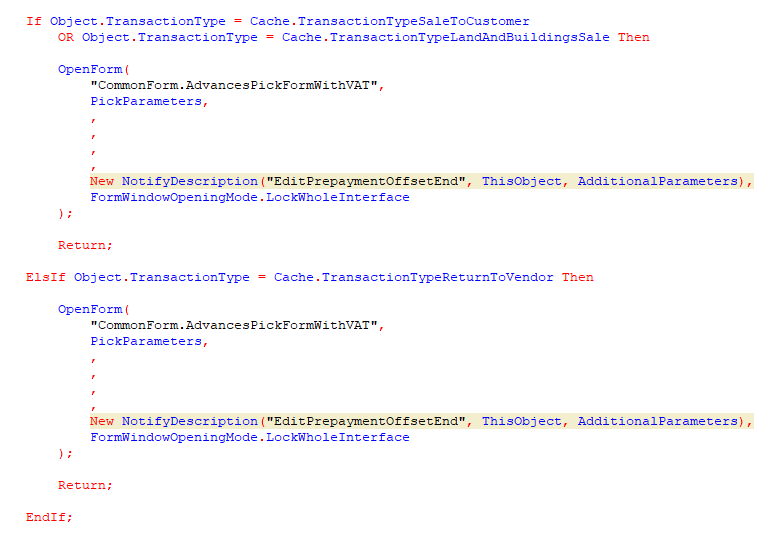
If the type of operation is the sale of goods or real estate, then open the common form AdvancesPickFormWithVAT with the parameters defined in the PickParameters structure. The callback is EditPrepaymentOffsetEnd method, defined in the same module; pass it the AdditionalParameters structure. The form needs to be opened so that it locks the whole interface.

However, if the type of operation is a return to the supplier, then open the general form AdvancesPickFormWithVAT with the parameters defined in the PickParameters structure. The callback is the EditPrepaymentOffsetEnd method, defined in the same module; pass it the AdditionalParameters structure. The form needs to be opened so that it locks the whole interface.

I hope you won't confuse.

Reuse Carefully
8 February 2022 ·

I'll tell you about a funny and a little embarrassing case that I took apart in January. The essence in a nutshell: a huge auto-test based on Vanessa, which is intended to check the VAT calculation, falls somewhere near the end.

I start investigating. First, I look at the screenshots in Allure: OK, the reason is obvious – in one of the documents, the conditional appearance for the field with the VAT amount doesn't work. The test expected it to be unavailable if the VAT rate is zero, but it turned out to be available somehow.

It's a mess, it needs to be fixed! I look at the condition in the code: well, it locks the field if the VAT rate is in the list of “zero” rates (list of VAT rates whose rate is equal to zero). Everything appears to be simple and logical. What the hell could possibly go wrong here?

Tweet

Well, I try to reproduce the bug manually. And there, all of a sudden, everything is nice: the conditional appearance works as it should. Floating bug, or what? I run the auto-test again, at the right moment I jump in with the debugger and find some outright garbage: in the list of “zero” rates, besides themselves, there are a bunch of empty links!

Frankly speaking, I was scratching the back of my head. The document receives this list from the common module with this code. An empty ref from here, even theoretically, cannot be obtained. Moreover, the module has the “Reuse Return Values” option ​​enabled, and the function is actually executes once somewhere at the beginning of the test, before all complex data manipulations. So, the test cannot affect it in any way, in theory.

Is it a dead end? Well, experienced colleagues have probably already guessed everything, but I had to dance around the bug and even check the standard, until got the following: return values ​​cache in 1C can be changed. I mean, not by calling RefreshReusableValues​​(), but by changing reusable values directly.

How? Well, if you get some values ​​from a cached common module, and they are not of a primitive type (string, number, etc.), you will not get the value itself, but a pointer to it somewhere in memory. You write this pointer to a variable and try to change it – you change the cache.

It's that simple, yes. This is what happened in my case: the form of another document called the method that generates the list of “zero” rates. Having received a list of values, it added an empty ref to it and used it in its logic. Thus, each time this form opens, the list cache contains more and more empty refs, which eventually broke the document at the other end of the configuration.

Tweet

In a good way, the platform should throw exceptions when developer trying to change the cache, but until this happens, you have to take care yourself. For example, when developing cached modules, return immutable data types from them (FixedStructure instead of Structure, FixedArray instead of Array, and so on). True, this is not a 100% protection: firstly, fixed types are not applicable everywhere, and secondly, even in the latest versions of the SSL, this is far from being done everywhere. Do you know many configurations not based on SSL?

Sonar also know nothing about the problem, as well as less popular software. No silver bullet, in short – check your code, look at the code of your colleagues and try not to forget about another elegant way to bang ourselves in the foot.
Infostart Event 2021
16 November 2021 ·

Last week I visited Moscow for Infostart Event 2021:

  • Listen to numbers of interesting reports — check;
  • Meet a few cool people in real life — check;
  • Chat with friends — check!

As a result, I suddenly felt rested despite the flights, stress, and fuss. I think it's because I'm working remotely, so it was really cool to look at so many colleagues in real life (not as a stream of electrons, I mean).

In order not to get up to fly twice, I passed the first test for PostgreSQL administration in the PostgresPro office. There are three more tests ahead, and the final one does not exist at all yet — but the walking one will master the road, I guess.

Matryoshka
30 October 2021 ·

A few days ago, there was a link to 1Ci certificate in the team chat (a colleague passed their junior course). I go over and see no auth form, no errors — I just get a PDF file. Everything is OK, right? Well, then I open the file:

Error.pdf

Honestly, I am even delighted. We need to implement this UX in our products: you press, for example, the “print” button for a document, and it gives you a PDF! And inside it — a link to another PDF! And inside it — “entity is not filled”, so go fill.

You can sell it as a Russian way of dealing with errors. This is, like, for historical reasons! Blame all the damned matryoshkas, and Koschei with his needle. It is, as you remember, in the egg, and it is in the duck, which is in the rabbit, tucked into the chest, and further along the chain of nesting.

Top Salaries
2 October 2021 ·

There is a path to a CSV file. You need to open it, read the header (first line), find the Salary column and display the top 10 salaries.

Link

Threw in my two cents just to complete the picture. If you forget about stability, readability, and performance — you can cut it in half. Here it was obvious from the very beginning that it would be shorter in bash and clearer in Python, so I just wrote it as I was used to.

What was useful: there are a bunch of examples in other languages ​​in the comments to the post. Frankly speaking, I haven’t come across some of them; it was really curious to look at the syntax and try to understand the way to solve the task.

In general, the whole story reminded Eugene Stepanishev's hobby — to write the output of the American “beer song” in all languages ​​in a row. By the way, Tonsky's issue looks as fun for me too — too trivial to seriously compare something on its basis.

What was funny: for a couple of colleagues, the 1C code caused such acute vision problems that they considered it necessary to report it :-) I partly understand the desire to assert itself on the stereotype “1C is bad, mkay?”, but it's the wrong case. The preference in syntax is nothing but a matter of taste, and besides it, the solution in 1C is no different from solutions in any other language without a built-in library for parsing CSV.

Hammer & Nails
15 September 2021 ·

I was developing payment documents in our configuration last week and came across an incredibly redundant solution to a primitive problem. Sorry, I can't keep to myself.

Just imagine: you have a document, which contains several tabular sections. Each of them has a comment field. You make a print form for this document; if at least one row of any TS contains a comment — you need to use one template 1, if there are no comments — template 2.

The task is pretty primitive, isn't it? All of us have done something like this a million times. Just read the selection, use IsBlankString() on the comment field and load the appropriate template. Coffee time!

However, instead of a short cycle, I saw this:

There is a chain of queries, in the lowest of which we scan all the TS (which, I remind you, we just raked out for printing). We are looking for comments in them, then we group the result several times and return it to the script.

Well, I'm not even talking about the load on the DBMS (I would venture to guess that this trick doesn't give a noticeable effect — after all, the selection is going to be small). It's just… Well… Checking a selection of rows is, like, five lines of code. Clear, simple, short, Sonar has no room to swear. How could you give birth to this? Because of great love for queries?

You know what? I bet that it's the correct answer. I can almost see this programmer, who has just mastered the query language more or less tolerably. He is in the absolute delight of new opportunities, so… If all you have is a hammer, everything around looks like nails.

No Comment
8 September 2021 ·

I did not notice when I gave up the habit of pedantically commenting on every method with which I have to work. This practice has some clever name for sure, but I don't care, to be honest. I mean the style when a description is added to every meaningful block of code, like this:

The meaning here is simple: when you dig in some dense legacy and run back and forth between chaotically scattered, big procedures — it is rather difficult to keep the logic of each of them in your head. The next cup of coffee will wash everything away. Therefore, such notes greatly speed up orientation on the ground, and the more time passes between approaches to the code, the more noticeable the effect.

However, at some point it became clear that this know-how is just a crutch supporting the frankly crappy code design. If you have a long procedure or function - take a breath, sit down and cut the fatty one into smaller methods. You will save both time and nerves, and you will figure out the code faster, and you will delight SonarCube.

The Date Literal Problem During Totals Recalculation
6 February 2021 ·

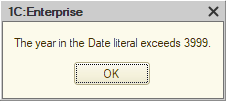
So, during a routine totals recalculation from the Configurator, we suddenly got the error: "the year in the Date literal exceeds 3999". Which means there's a date somewhere in the database — or trying to get there — that is beyond the maximum 1C can handle: 31.12.3999 23:59:59.

Exception

Alright. What do we do with that?

The main thing is to identify the exact table that contains the bad dates. Since the error showed up during totals recalculation, the obvious place to look is the registers. Open the standard totals management tool, start recalculation, and you'll get the name of the register the platform trips over.

Another approach — more proper, methodologically speaking — is to enable tech log collection (SDBL, EXCP, and EXCPCNTX) and get a log that looks roughly like this. In that log, find the EXCP event, and right before it the SDBL event. That SDBL entry contains the SQL query that caused the crash. In its text, you'll see the table name you need (AccumRgTn11530). The corresponding configuration object name can be pulled out with pretty much any utility built around GetDBStorageStructureInfo().

One way or another, you end up with the register name. Open its form, sort by period, and you'll quickly get to the bad entries. Then the job is to inspect the documents that created those records, fix the root cause, and repost the documents. If totals recalculation is still broken after that, then either this is not the only table with broken dates, or those dates have already spread somewhere beyond the records table.

For example, I once had a case where fixing the records was not enough, because records with invalid dates were still sitting in the turnover table. The platform itself could not remove them, but the database was small enough that I could get away with some restructuring tricks. I pulled the following stunt: turned off the "Use in totals" flag for all register dimensions and applied the changes; then turned it back on and recalculated totals again. As a result, the register's turnover table was physically dropped, then recreated and filled from scratch — this time without dates from the distant future.

As a last resort, you could delete the bad records with direct SQL queries (DELETE or even TRUNCATE). But first, that violates the platform vendor's license agreement, and second, it's risky: it's very easy to remove something important and not notice until later. So I would, uh, not recommend trying that at home.

Nerd View
19 October 2020 ·

A chat with my daughter

On the screenshot above my little one is just letting me know where she is: walking down the street, at the school, at a playground. It's not her fault that I have a sort of nerd view: when I look at this chat I see nothing but code on Gherkin, which is just a bit broken. A little patch here and there and it will be fine :-)

And I exit home
Then I enter school
And I exit school
Then I gonna swing

We use Gherkin to write our autotests for Vanessa Automation. I can't say I've made very many of them, especially in comparison with some of my colleagues… Well, it seems like I've made them enough to twist the reality a few.

Message to User
30 April 2018 ·

1C:Enterprise has a convenient and accustomed method of showing information for a user — it's a UserMessage object. It outputs messages at the bottom of a form and suddenly it's a potential problem. The thing is, most users don't look at it. It's like: well, I see no critical errors for now so there is nothing to worry about.

Therefore, in case an error happens or you just have an essential message, you should show it through a dialogue window — by the ShowQueryBox() method or a ShowMessageBox() method, for example. Otherwise, a user may not notice a problem and continue to work in spite of some action might not be executed or might be executed in a wrong way. The issue will come out later and you will be rightfully blamed for it.

In addition, using of a UserMessage object should be prohibited in case of small service forms. Yes, in fact, it's hard to overlook a text if a window is small, but that's a different matter: the messages below literally devour form's workspace and it becomes hard to work with.

Why So Serious?
17 February 2018 ·

Sometimes when you developing some complex mechanic you don't have enough time time for the adequate naming of variables. As a result, there is a lot of mysterious WhatTheHeck, ApplyMagic and bunch of other LivingFailures.

It's what you should avoid despite it looks funny. You'll rewrite code you've written month or two later and it will be hard to shame its author because it is you.