Notes: Work

My notes about life, work and other fascinating things around me.

Shown: 0 · Page

The Year In The Date Literal Exceeds 3999
28 Marth 2026 ·

I already wrote about the error mentioned in this post’s title earlier, but here's the refresher: the platform chokes on dates later than the year 3999 (things start blowing up at 3999-12-01, I guess). In theory, dates like that should never make it into the database in the first place. In practice... Well, thanks to bugs in application code — and in the platform itself — they sometimes do.

The usual symptoms are pretty random and annoying: some reports stop working, some documents refuse to post, totals recalculation crashes, and so on. Basically, any code that touches records with those broken dates is now having a bad day.

The fix I outlined in the post linked above does work, but it's relatively slow: you need to configure the tech log, collect the output, and then parse it. The problem is that the platform crashes the moment it touches the first bad date, and there may be lots of them scattered across different tables. So you often end up doing this in multiple passes: run a check, hit an error, fix it, run again, hit the next one, repeat.

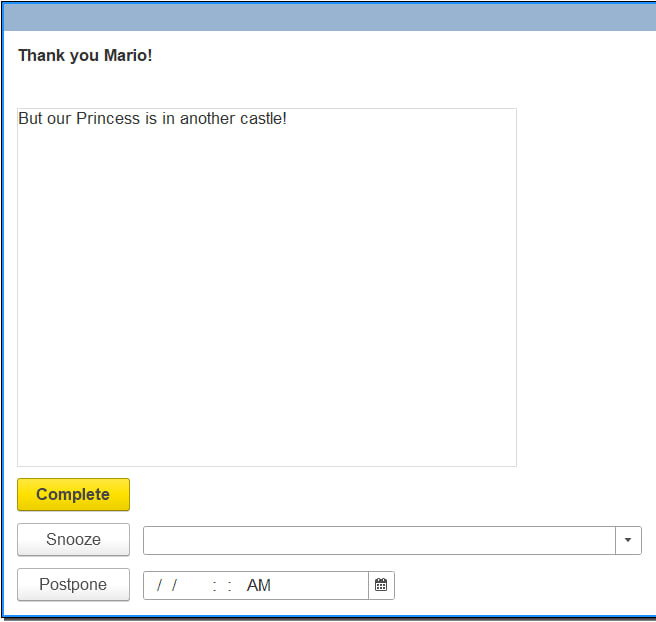
Thank You, Mario!

A few years ago, because I wanted a faster way to deal with this, I wrote a PostgreSQL query for it. The idea is simple:

  1. Find all date fields in the database.
  2. Build one giant query against those fields to look for dates beyond 1C's limit.

So yes, this query generates another query. Very normal behavior. Run the generated query, and you get the full picture: a list of tables containing invalid dates. After that, it's just engineering work — inspect the tables and decide what to do. In our case, bad dates sometimes show up in totals and turnovers, so we can just delete those rows and recalculate totals using the standard tools.

Why do this at the DBMS level? Because 1C itself can't really help here — as a reminder, the platform crashes as soon as it touches the bad records. That includes reads, not just writes. Also, in this case, going directly against the database is simply faster and more convenient.

The other day I rewrote the same query for MS SQL. It turned out longer — because, well, MS SQL likes to make you earn it — but the idea is exactly the same.

If you want to use it, keep this in mind:

  • The _Fld626 field in the query text is the Fresh separator. In your database it may have a different name, or it may not exist at all.
  • The query is written for a database that uses a 2000-year offset. If your database does not use that offset, you'll need to adjust the condition accordingly — see DATEADD().
  • I added the XML output trick (FOR XML) to stop SSMS from truncating the generated mega-query. That seemed faster than messing around with type casts. The side effect is that before running the generated query, you need to replace > with >.
With Side Effect
15 Marth 2026 ·

In the latest release of our ERP, we optimized several heavy dynamic lists — orders, invoices, proforma invoices, and so on. Over time they had accumulated a pretty solid pile of technical debt, mostly in the form of mountains of helper tables bolted onto the main queries: contact info, technical attributes, balances, turnovers, you name it.

At some point even in fairly small deployments the DB optimizer started producing complete nonsense instead of query plans, and the resource cost of letting that happen was getting less and less funny.

So, we patched things up using several different approaches. One of them was loading extra row data inside the OnGetDataAtServer() handler (I actually mentioned this mechanism not that long ago). We built a nice little framework around it, rolled it out, tested it, and... Well, now we're all sitting here with those deeply unimpressed engineer faces.

To be fair, performance really did get a lot better. Inside a compact handler, you can tune queries against heavy virtual tables almost perfectly. The problem is somewhere else: field values populated by this handler are not passed into the standard dynamic list mechanisms. Which means search, sorting, and grouping simply do not work for those fields.

So you type a value that is clearly visible in the column — and the row is not found. Or not all matching rows are found. Or rows show up that visibly should not match at all. From the user's point of view, this looks absolutely terrible. A bug is a bug. Those fields don't look any different in the UI, so how exactly are you supposed to explain that this is "just how the platform works™"?

And if you explicitly exclude such a field from the mechanisms that can't handle it, that's somehow even worse. For example, try to sort by it — and boom, giant error message. Explaining why sorting blows up on this "Amount" column while the one right next to it works just fine is... Not exactly a beginner-friendly support conversation.

Honestly, how do you come up with such a great handler concept and then completely fumble the platform-level implementation?

This randomly reminded me of Reddit. Some communities love threads like "invent a superpower, but with a side effect". Like, one person comments: "I can run at the speed of the wind!" and someone replies: "yeah, but you can't stop". That kind of thing. Sometimes it gets pretty funny.

Superpower

That's basically the kind of conversation we're having with the platform developers. You can massively speed up dynamic lists, but the UI will make your users furious. You can automatically send binary data to an S3 bucket, but lose it all with one careless click. You can teleport anywhere, but it takes exactly as long as walking. You can shapeshift, but only into an elderly pug. You have thick, silky, luxurious hair, but on your ass.

Autosummary
8 February 2026 ·

I started recording all my meetings back in 2020 — at least, that’s what my own notes say. Video is always more accurate than memory, and clicking "Start Recording" in OBS is the cheapest way to not lose some random-but-important detail.

The downsides are obvious, though: you can't quickly grasp the gist of a meeting from a video, searching through it is basically impossible, it eats disk space like it's bulking season, and it's painfully easy to accidentally capture something private. To partially compensate, I used to jot down key points in bullet form during the meeting, and later either throw them into a task tracker or write a mini-summary for myself: who I met with, what we discussed, what decisions we landed on. If I forgot something or missed details, I'd double-check the video.

But this method isn't perfect either. Even a rough outline steals focus from the actual meeting. And some "oh right, that detail matters" moments only reveal themselves when it's already too late.

Forgot

So I ended up with a better approach: extract the meeting audio from the video, turn it into text (with a neural net), then turn that transcript into a detailed meeting summary (with another neural net). Yes, it's neural nets all the way down.

The easiest way to rip the audio is with ffmpeg (a command-line utility for working with audio/video). Here's an example (mono, 16 kHz sampling rate + loudness normalization):

ffmpeg.exe -y -i "D:\video.mkv" -vn -ac 1 -ar 16000 -af loudnorm -c:a pcm_s16le "D:\audio.wav"

As for speech-to-text: I experimented with Vosk + recasepunc, but... Yeah, no. Let's just say I'd rather not relive that experience. Meanwhile Boromir Whisper (OpenAI's speech recognition model) installs in the background in about 10 minutes:

py -3.10 -m venv .venv
.\.venv\Scripts\Activate.ps1
pip install setuptools wheel
pip install torch torchvision torchaudio --index-url https://download.pytorch.org/whl/cu118
pip install openai-whisper

Example run:

whisper "D:\audio.wav" --model small --language Russian --output_format txt

The result is a plain text transcript you can shove into any chatbot and get a fairly coherent summary. Sure, you still need to proofread it — fix mistakes and hallucinations, rephrase a couple things — but it's still way better than trying to write notes live.

And that’s basically the whole method. The only thing left is writing a simple script so you don’t have to run two commands manually every time. If you’re on Windows and you can't be bothered to vibe-code, you can grab my script and tweak it.

The script finds the first .mkv in its folder, runs it through ffmpeg + Whisper, and saves the result back into the same folder. If you use it: note that it runs via CUDA (CPU works too, just much slower), and it stores downloaded Whisper models not in the default cache, but inside the current Python virtual environment folder.

(if you really want, you can wire up an API call or point it at some local model via LM Studio — but for my personal setup I decided: nope, that's already too much engineering for a lazy win)

New Blog's UI
17 January 2026 ·

Over the New Year holidays I randomly got obsessed and rewrote my blog's UI. I only wanted to add search for my notes — there are a lot of them now, and every so often I need to quickly fish something out of the pile (like "here's that link" to a coworker).

The blog runs on GitHub Pages, so the options aren’t exactly infinite: either outsource search to Google, or build a static index and ship it to the user's browser so it can grep through it locally. I went with the second route: faster, more controllable, and, yes, an excuse to write code. The first time you search it has to download the index file, but... It's 200 KB. That's basically one medium-sized sigh in 2026 internet terms.

And then, you know how it goes... Scope creep grabbed me by the hoodie. First I couldn't get Tachyons to play nice with the search input — got annoyed and migrated everything to Tailwind (I'd been meaning to try it anyway, just never had a "good reason", so I invented one). While I was writing the search code, I figured it'd be dumb not to add tags too, because why do the same work twice. Next thing I know I "wake up" and there's a whole tag cloud sitting above my notes. At that point it felt only logical to do the same for the projects page — except there it's not tags, it's tech stacks...

So yeah, it turned into that "Fear and Loathing in Las Vegas" meme. The tendency was to push it as far as I can, kinda.

Now the only thing left is to make myself actually write into the new project log. There's always a ton of work, and it's genuinely interesting — but if I don't write things down... Welp. Everything sinks into coffee.

Backup Management
6 December 2025 ·

At the end of the year we shipped a big update to our internal tool (I briefly wrote about it before). The goal: give teammates sane, usable access to backups of customer apps. In a SaaS company, everyone needs backups all the time — dev, QA, incident investigations, you name it. Without proper tracking the whole thing turns into a petting zoo: three people, same moment, three requests for almost identical copies of the same database. Sure, it "works", but you end up chewing through 3x the resources for zero extra value.

We did have a solution built on top of the Bitrix UI, but due to, uh... the unique "evolutionary path" of that product, it delivered more pain than gain. So we rethought the workflow and rewrote everything. Frontend is 1C; backend is PostgREST, PostgreSQL, PowerShell, and a bunch of other bits and bobs. The internal logic is fairly gnarly, but for the user it's a clean, friendly UI where you can request a backup in literally two clicks.

You can pick one of three backup types:

  • Cloud backup (a copy of the real app deployed in the cloud and accessible — including via the browser);
  • File backup (a regular .dt file you can download and spin up locally);
  • Configuration + extensions backup (.cf + .cfe).

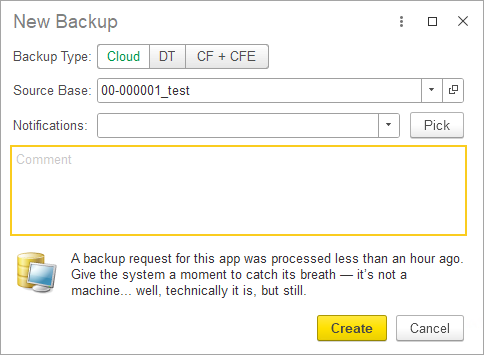
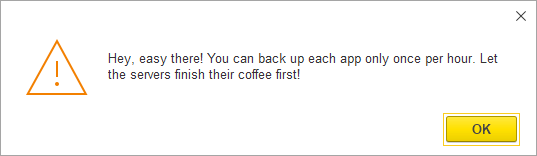
Also, the new solution detects when someone tries to request a backup for an app that's already being generated right now. And it rate-limits things too: you can't back up the same app more than once per hour.

And yes — we're still sneaking jokes into the UI. Obviously.

But Still!

Coffee First!

Desire Paths
29 November 2025 ·

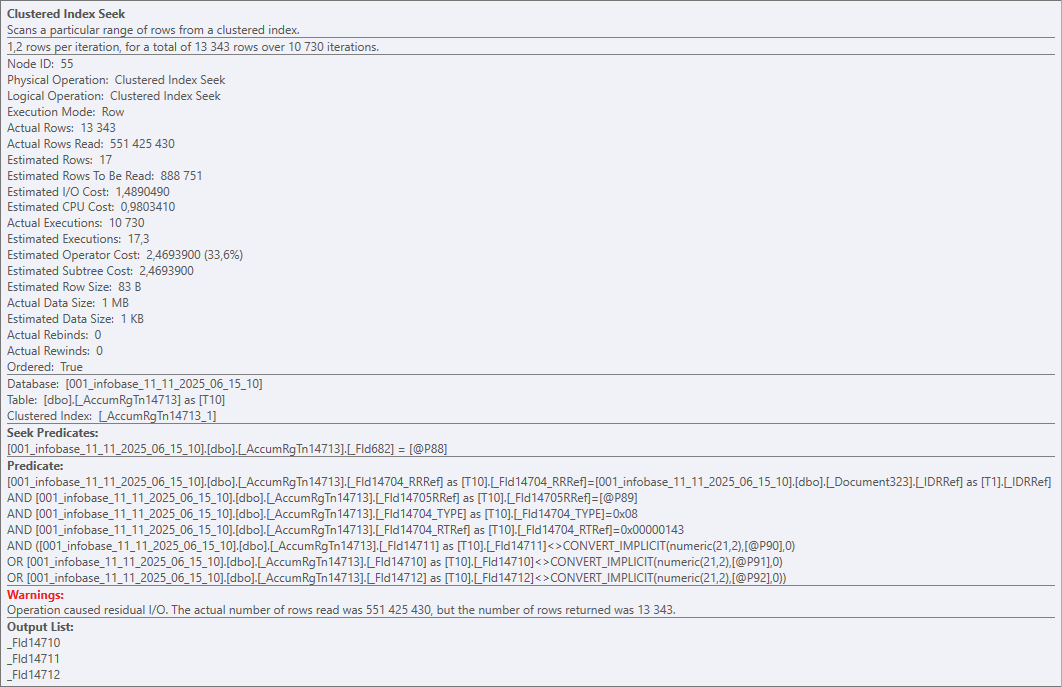
Alright, Jean Fresco's riddle. You've got a table — say, ~50k rows. How do you end up reading half a billion?

Easy-peasy: Nested Loops + Clustered Index Seek:

Half a billion

Clustered Index Seek is a bit of a marketing name here, of course. In reality, on every execution the operator walks the entire table (the whole clustered index) and checks every row against the predicates. And it does that 10 730 times for 51 391 rows. Result: 551 425 430 rows read, 13 343 returned.

Ouch

So yeah — a perfect textbook example of a horrible query plan in a vacuum. Put it in a museum. Nested Loops, if you've forgotten, works roughly like this:

For Each Table1Row In Table1 Do
    For Each Table2Row In Table2 Do
        ...

That's fine for small tables, but the DB can also pick it for bigger ones — for example, if it runs out of time to build a proper plan.

That's exactly what happened here. Zooming out to the platform level: we've got a dynamic list that queries a documents table, and the devs bolted on like a dozen virtual tables from accumulation registers.

Some of those registers were huge on their own, and the virtual tables poured gasoline on the fire (each one turns into 2+ nested queries). The DB honestly tried to come up with an efficient strategy, but at some point it basically decided: "a garbage plan is still better than no plan at all".

And the user? They tried to search a document by number — and the client app just straight-up froze.

So, about virtual tables in dynamic lists. There's a nice English phrase: "desire path" — the trail people naturally carve because it's the easiest way. Slapping a virtual table onto the main one really is often the simplest, fastest, most familiar way to solve the task. But it's not efficient.

There's an alternative, for example the OnGetDataAtServer() handler. It takes longer to implement, but it lets you properly tune the virtual table and avoid the scenario above. Scrolling the list will produce more queries, sure — but they'll be smaller, faster, and way more efficient than one single giant monster query.

Voodoo
5 October 2025 ·

Looks like we finally caught our first lab-reproducible case of platform cache corruption. Short synopsis:

  • Spin up a fresh app from the v35 template of our ERP.
  • Run it and wait for initialization to finish.
  • Swap the app configuration to the v36 release (specifically build 28537 from the dev repo) and run it again.

After this super simple sequence, about half the team sees the platform suddenly lose one of the enums. And it's annoyingly selective: hit an enum value on the client — all good; do the same on the server — boom, exception.

Same story with the manager module of one catalog: its methods exist and are exported, but after the update the platform pretends they don't and throw an exception when you call them.

Welcome To Dipshit Central

As always, when the magic blooms — look at the cache. Clear it and symptoms vanish. There are indirect hints too:

  • The enum did exist in v35, but it was renamed in v36.
  • Those manager-module methods didn't exist in v35 (they were added in v36).

So the v35 cache didn't contain either of these in their v36 identities, yet for some reason the platform insists on digging into that old cache.

We still don't have a clean root cause. We traced it to a specific commit after which the bug started showing up, but the only weird thing there its its name (and honestly, there are nearby commits that look even more suspicious from this point of view). The rest were minor changes that regenerate internal metadata IDs in the manifest. Yes, those IDs are tied to cache keys, but they get bumped on any metadata change and have never caused issues before.

If you landed here from Google because you hit the same mess — make a no-op change to the problematic object so the platform refreshes the metadata IDs in the manifest. For example, add an empty method or even just a space in the module. That fixes the configuration so the recipe at the top stops corrupting the cache.

Voodoo, sure — but hey, it works ¯\_(ツ)_/¯

Slow Removal of Fresh Areas
3 August 2025 ·

A colleague noticed that on one of our Fresh instances, deleting data areas had become painfully slow. Dug into the metrics:

DELETE FROM T1
FROM _DataHistoryMetadata T1
WHERE 
    T1._MetadataId = ?
    AND T1._IsActual = 0x00 
    AND NOT (
        T1._MetadataVersionNumber IN (
            SELECT T2._MetadataVersionNumber AS MetadataVersionNumber_
            FROM _DataHistoryVersions T2
            WHERE T2._HistoryDataId IN (
                SELECT DataHistoryLatestVersions1.DataHistoryLatestVersions._HistoryDataId AS HistoryDataId_
                FROM DataHistoryLatestVersions1.DataHistoryLatestVersions T3
                WHERE DataHistoryLatestVersions1.DataHistoryLatestVersions._MetadataId = ?
            )
        )
    )

Each of these queries was reading around 20GB. What's happening is mostly clear: the platform is trying to delete an area's data history, but the janky DB query causes a full scan over the whole history table across all areas instead of using an index. Someone on Dmitrovskaya got lazy again.

Why are you surpised?

So we were losing between 30 seconds and a half an hour per operation. Wanted it faster. Fix:

CREATE NONCLUSTERED INDEX IX_DataHistoryLatestVersions1_MetadataId
  ON dbo._DataHistoryLatestVersions1 (_MetadataId)
  INCLUDE (_HistoryDataId)
  WITH (DROP_EXISTING = OFF, ONLINE = OFF);

CREATE NONCLUSTERED INDEX IX_DataHistoryVersions_MetadataVersionNumber
  ON dbo._DataHistoryVersions (_MetadataVersionNumber)
  WITH (DROP_EXISTING = OFF, ONLINE = OFF);

Deletion cost predictably dropped ~99%.

If you're going to repeat this on your side:

  1. Technically this violates the license agreement, you've been warned and all that.
  2. There's a risk the platform will trip over the new indexes during future restructurings (especially on the "new" schema). Better to have a ready script to drop the index, and then (after restructuring) put it back.
No
11 June 2025 ·

No

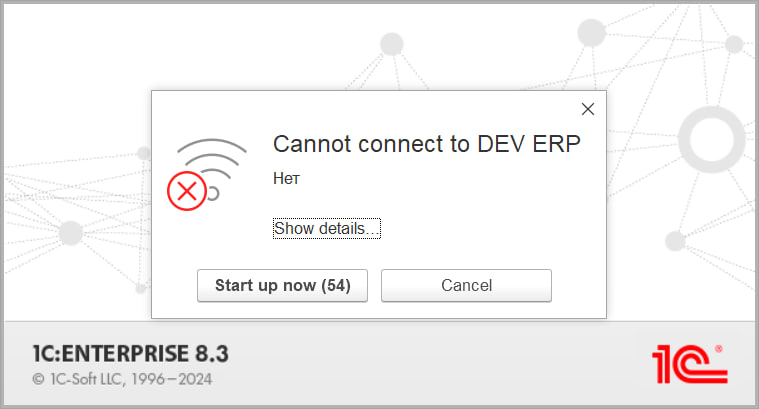
This is the message the current platform throws up when you try to connect to an offline server cluster. I do appreciate minimalism in interfaces, of course, but this is definitely over the top.

What's more, the platform is installed with only a single language pack (English) and even launched with a hard override to "Ven VLen", yet somehow the native birches still manage to sprout up. Maybe the C++ library that fires off the message (DataExchangeTcpClientImpl.cpp) is looking at the OS language (Russian) in my case — hard to say.

Anyway, I can't shake the Bugs Bunny vibes every time I see that dialog box.

No

Easter Eggs
6 April 2025 ·

Thank you, Mario!

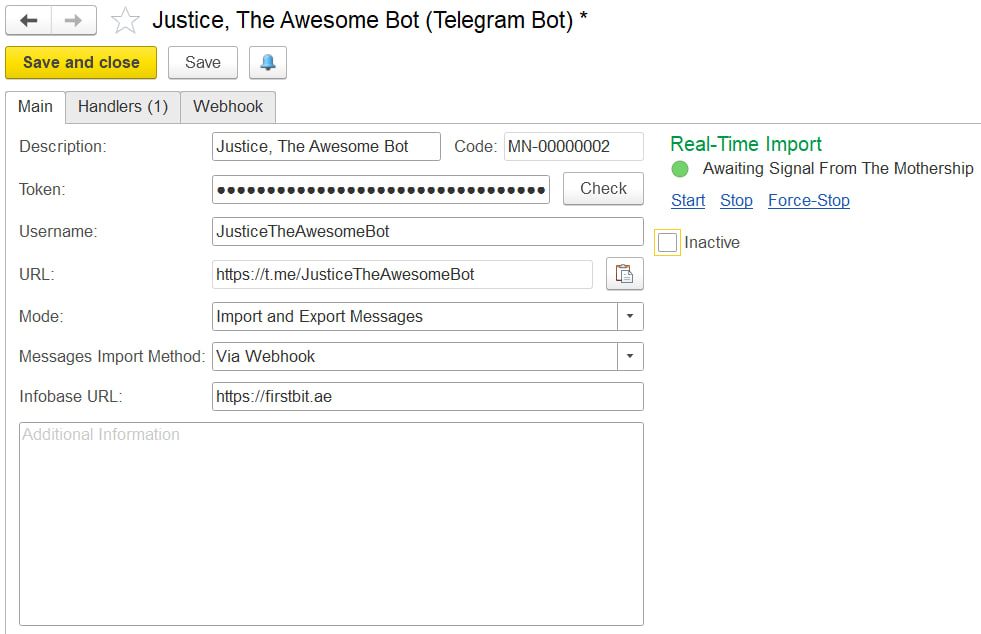
Awaiting Signal

A couple of Easter eggs hidden inside FirstBit ERP. They're tucked away for the developers: in the first case, users see just the form title and notification text, while in the second, they see the standard "waiting for connection" message.

I like to add little things like this from time to time — it helps to keep things fun, even when the task isn’t the most exciting or I’m just feeling tired. If you haven’t checked out Bystronovsky’s "Design Without Stress", you really should — no way I could explain it better myself.

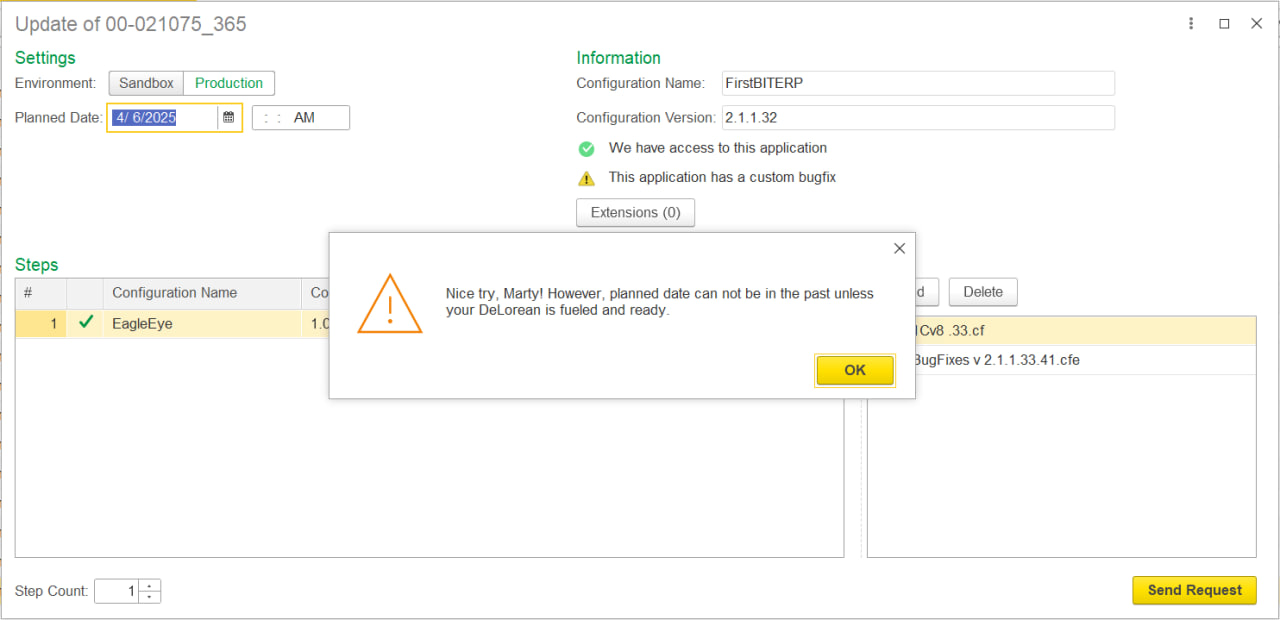
By the way, here’s another Easter egg! Not from our ERP this time, but from a new tool we’re making for automated database updates. We're building it just for ourselves, so we can joke around with the user a bit :)

Nice try, Marty!

ERP Development In English
19 January 2025 ·

Our lead developer recently shared some insights about our work — specifically, developing ERP systems on 1C for the UAE and, more recently, Saudi Arabia. The session was hosted by the online English school Across, so the audience was spot-on: Russian-speaking folks interested in building careers and exploring international markets.

Overall, it turned out pretty cool, especially as a language practice. Just a reminder: learning foreign languages is still one of the best ways to give your brain a workout, and it’s also super accessible. There’s no shortage of resources, communities, and interest-based clubs out there — you just need the motivation :)

A Little Bit Of Surgery
17 December 2024 ·

A few years ago, I stumbled upon a story about a programmer who had to debug software controlling a surgical robot — right in the middle of an operation. That blew my mind, to be frank.

Today, my colleague and I were fixing a 1C cluster with databases running on 1cFresh. After migrating it to a neighboring server, the thing suddenly started acting up. Long story short: trying to print a document would send the client app into its death throes.

While we were knee-deep in troubleshooting, I had this thought: sure, it doesn’t look as terrifying as debugging software that someone’s life literally depends on. But if you think about all the clients sitting on edge because their business is grinding to a halt... Well, who knows where the stress levels are higher?

P.S. Nerdy details for the curious. During the migration, the permissions for the server cache folder didn’t transfer properly. This led to a funny (well, not so funny) effect: the logs would happily land there, but session data wouldn’t.

So, when someone opened a print form, the configuration tried saving it to the storage, and rphost, in turn, attempted to shove it into the session cache. Here’s where things went sideways: the worker' process (probably) got slapped on the wrist by the OS. Due to (apparently) some funky file system event handling in the platform, the exception wasn’t caught, so the poor thing had no better idea than to kill the session. Naturally, this caused the client process to crash.

We fixed the permissions, rebooted the cluster, and voilà! The problem was gone.

End of Report

All other hypotheses — cluster manager acting up, lack of hardware resources, configuration bugs, client-side issues, broken security profiles, network problems between the client and server — got tossed out during the diagnostics process.

Summary to Slack
10 November 2024 ·

I found a script that I wrote a couple of years ago for our work GitLab. In short, we run our development repository through a barrage of tests on Vanessa daily, resulting in a nice report showing how many tests passed, which ones failed, the reasons for failures, and so on.

The report needs to be analyzed regularly, at least at a glance. Of course, we haven’t seen fully "green" tests in a long time, and that’s expected: for example, in the case of interdependent development, commits can break the checked functionality, and the tests still need adjustments. However, keeping a pulse on it is still essential.

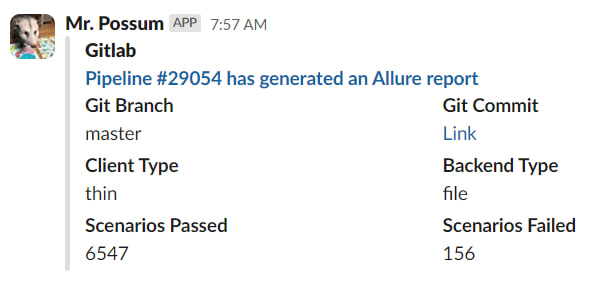
To simplify this routine, I expanded the pipeline code a bit: after generating the report, GitLab first creates a brief summary (client type, database type, test statistics) and sends it to Slack.

Report

As a bonus, it’s now easier to answer the philosophical question, "who broke everything". Most often, it’s the author of the first commit on which the Scenarios Failed metric in the screenshot above hit the ceiling :)

About PDF
6 September 2024 ·

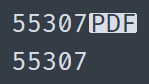
I get a complaint: a client can’t log into our customer portal. I check the database — the account is fine. So what’s the problem? I check the login and see a strange sight:

PDF

Above is what the user entered, and below is what’s in the database. My first thought: how on earth did a document end up in the string? :D

I’ll skip the further investigation. The key here is asking the right questions (otherwise, both Google and AI will be thinking about the popular file format, not the symbol). So, PDF in the context of Unicode means Pop Directional Formatting! It’s a symbol that controls text direction; it’s needed, for example, to properly render Arabic (which can contain both left-to-right and right-to-left text). The user obviously enters the login in RTL mode (or copies it from somewhere), and the portal does not understand this nuance.

In short, a piece of cake. However, I’d like to point out that the PDF file format existed long before the PDF symbol. I get that these are different technical fields, and the developers probably didn’t see the overlapping terminology as a significant issue. But deep down, I’m sure someone was smirking, anticipating today’s confusion.

Singapore Doll
22 June 2024 ·

Is it possible to love your country's currency more than the people of Saudi Arabia? It is a rhetorical question: the answer is no.

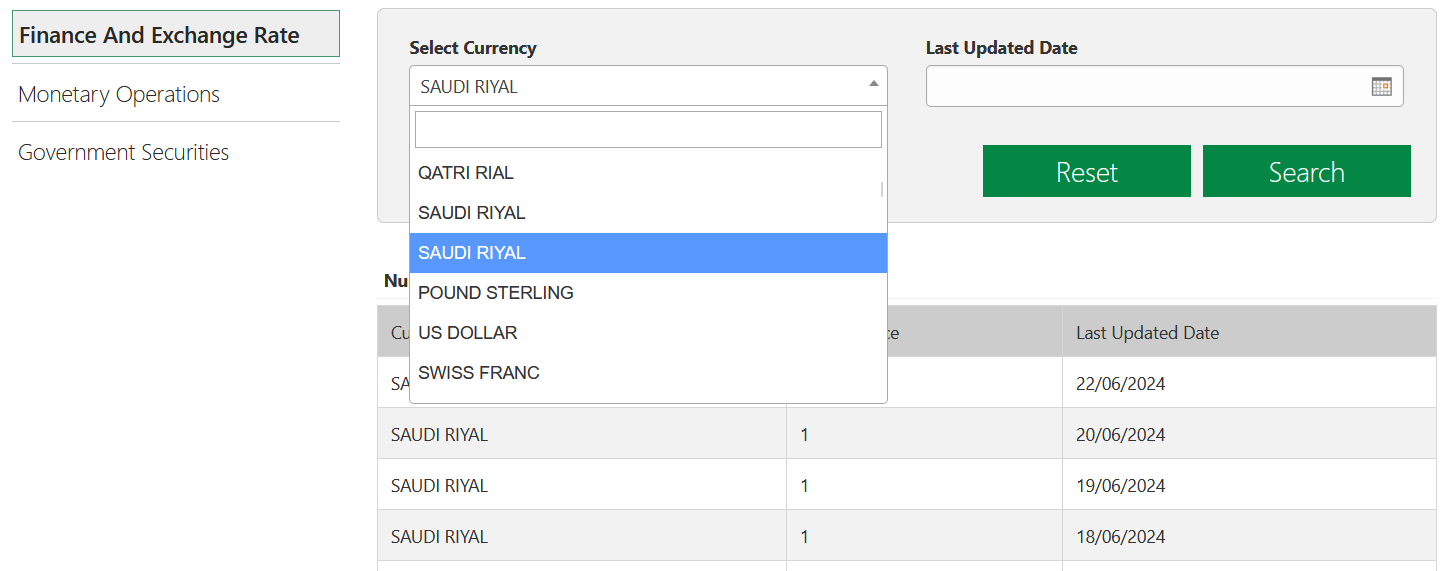
I'm currently looking at the website of their central bank. The country's currency is the Saudi riyal, and the Central Bank sets rates for other currencies in relation to it. Consequently, there is no point in asking the bank for the rate of the riyal itself. However, the website calmly suggests choosing it twice:

The selection form

For your information, the first option breaks the website, and the second one pedantically displays “1” for any date.

Another funny thing: colleagues seem to store currency names as 14-character strings. Otherwise, it is difficult to explain why, according to their data, Canada uses not the Canadian dollar but CANADIAN DOLLA, and Romania uses mysterious NEW ROMANIAN L instead of its leu. However, these two are rather lucky: Singapore, for example, conducts payments in SINGAPORE DOLL.

Screenshot With Sound
20 May 2024 ·

Recently, we came up with the idea of dividing the internal ERP into several independent parts and organizing data exchange between them. We discussed the outlines of the task, the exchange model, transport, and roughly agreed on deadlines — in general, we did what we usually do.

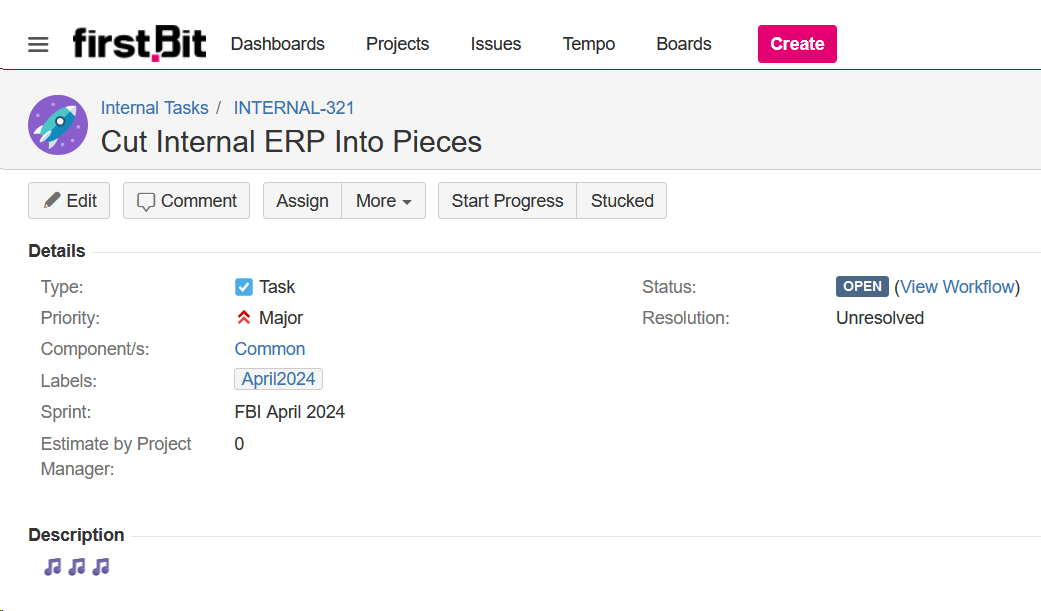
I created a task for the stuff. We give them names in English, so I wrote in the first wording that came to mind.

Cut My Life Into Pieces

The title came out with sound. Okay, this one is funny, but what should I call it then? Well, let it be Distributed Internal ERP. Abbreviated... DIE?

I let the first one be. Long live Papa Roach :)

Timesheet for Obsidian
12 May 2024 ·

I made another Obsidian plugin, this time for daily notes. Draws a nice report: what tasks I worked on, what I did, and how much time I spent. I tried to describe how it works in the repository; will be glad if it is useful to someone else!

Funny thing: for the examples in the README, I used issue numbers FBI-1, FBI-2, and so on. This isn't a reference to the X-Files or Twin Peaks — it's just the first thing that came to mind. The fact is that our internal project for the development of FirstBit ERP is called First Bit Internal, abbreviated as FBI. The main pool of tasks we work on lives in it.

We’re already used to it, but our colleagues outside the company always find our screenshots from JIRA or SonarQube amusing. Did you imagine that you were Agent Cooper? Well, I almost don’t even need to :)

Do? Do Not?
14 January 2024 ·

Among our projects, we have one where two systems are communicating with each other: ERP and CRM. Data exchange is done well: a push'n'pull server has been set up, subscriptions to events have been registered, a REST API has been implemented, and so on. There are many other fascinating technical details, but I'm not talking about that now.

The exchange has various logic chains inside. For instance, if a new company appears in CRM, it sends the data to ERP. The other day, a problem appeared: a company was not sent from the CRM, no matter how many times you tried to write it. So we went to investigate, suspecting the worst: CRM is written in PHP (nothing personal; it’s just not our technical stack), and there’s a lot of different legacy stuff there. It's easier to shoot yourself in the foot than to blow your nose.

However, it didn't take much digging. We opened the company’s page in CRM and saw that he had the “Do Not Export To ERP” checkbox, which, in fact, blocked the sending. A manager made an obvious mistake.

Should we uncheck the box and close the ticket?

Well yes, but actually no

This will solve the problem with that particular company, but not the reason it appeared. It is actually in the interface, specifically in the name of the option: “do not” is used, which is advisable to avoid due to the fact that it is more difficult for users to read the wording correctly. By the way, this also applies to a simple “do”.

It is often difficult for programmers to understand why this is so: we are used to instantly calculating Boolean expressions in our heads, and variations like “not (not true)” are commonplace for us. But people with a different background can get confused. Just a little, but sometimes this is enough for them to perceive “do not export” as “do export” in the heat of the day, click the option, and move on.

To sum up, the solution is to rename the checkbox. “Disable Export” or “Stop Export” are both fine, for example. “Prohibit Export” also comes to mind, but it’s more about interpersonal relationships, and in general, a ban on doing something does not mean that it won’t be done :)

Everyday Heroism
24 September 2023 ·

Some time ago, I was setting up Swagger for the internal API. While I was fiddling around, it became clear that some functionality did not need to be included in the documentation. I was looking for a way to do this without crutches and came across a funny question on GitHub.

What's funny, you ask? Well, I involuntarily remembered Mista. Among 1C developers, this is synonymous with the word “toxicity”: if you ask anything there, you get a bucket of slop by the collar instead of an answer. Here, of course, everything is not so neglected, but holy crap! These persistent guys who referring to the 14-page manual made me laugh a lot.

One thing is good: by the end of the thread, there appeared a brave rebel who just answered the question. They, like, named the required parameter for a FastAPI method's decorator, which is not supposed to be shown in the documentation. No links — could you imagine?

Not all heroes wear capes, I would say.

Romania's Feature
30 August 2023 ·

Making a password recover function via SMS for our customer portal. Got to the Twilio documentation related to alphanumeric sender ID support in different countries; this feature allows you to send messages so that the recipient sees not the sender's number but something meaningful (a company name, for example).

The feature is regulated differently everywhere: in some countries it just works, but in others registration is possible or even required.

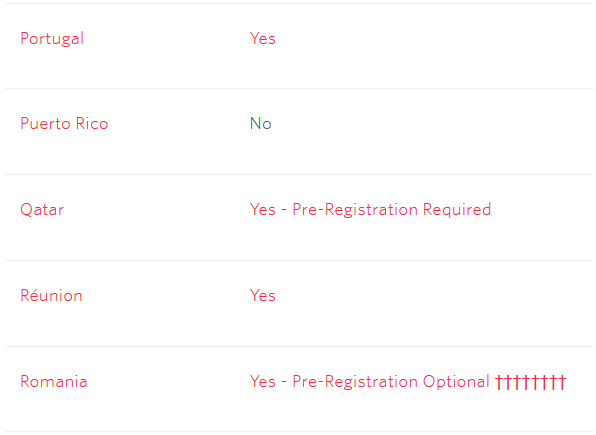
Well, let's take a look:

Screenshot

🤔

  • Portugal: yes
  • Puerto Rico: no
  • Qatar: yes (with registration)
  • Reunion: yes
  • Romania: yes (with registration) (but be afraid of Dracula)

I don’t know how else I can explain this cemetery.

UPD: Found the answer. Grave crosses mean you have to pay $700 to register.

To be frank, I like the explanation about Dracula much more.